

EIMI Training and Certification
You’re a great educator — but sometimes, you feel a gap.
That gap is the space between pedagogy, technique and what your student actually needs to succeed at their instrument. This training is the neuroscience-informed, evidence-based framework to help you reach every student, every time — now available as self-paced training, cohort courses, and a certification path for educators.
Music ed programs are busy - and they don’t cover this.
Pedagogy classes give you structures for teaching technique, not shutdowns. It tells you what to teach and how to scaffold, but not what to do when a student checks out, melts down, or can't get regulated enough to learn.
Every student deserves instruction that meets their brain, not just their instrument.
Where the gap actually shows up
Most music educator training covers technique. Almost none of it covers what to do when a student shuts down, melts down, or checks out — or how a brain that’s dysregulated, neurodivergent, or carrying trauma actually learns music.
That gap is where EIMI starts.
-
When a student has a dysregulated midbrain, their forebrains have less blood flow. In other words, a scared student can’t learn. Music educators who educate themselves on how to use emotional first aid with students will have better outcomes.
-
Most people think that to be a “musician” means to be highly trained, highly educated, highly skilled and competitive. But when we flip that definition on its head, we get more engagement from students and more buy in from administrators.
-
Music lives in the deepest emotional centers of our brains. There is no way for a music educator to teach music without being in their students’ most vulnerable mental spaces. Knowing what to do with that is the whole point of the EIMI structures.
Get equipped to do your good work.
Step 1 — Choose your path: Start with training (self-paced or cohort), or go straight for certification if you're ready to be evaluated.
Step 2 — Complete your training: Work through the ten sessions at your own pace or with a cohort — you'll have a full year of access.
Step 3 — Get certified (optional) and grow: Have your work evaluated, join the registry of EIMI Certified Practitioners, and — if you want — keep going toward coaching.
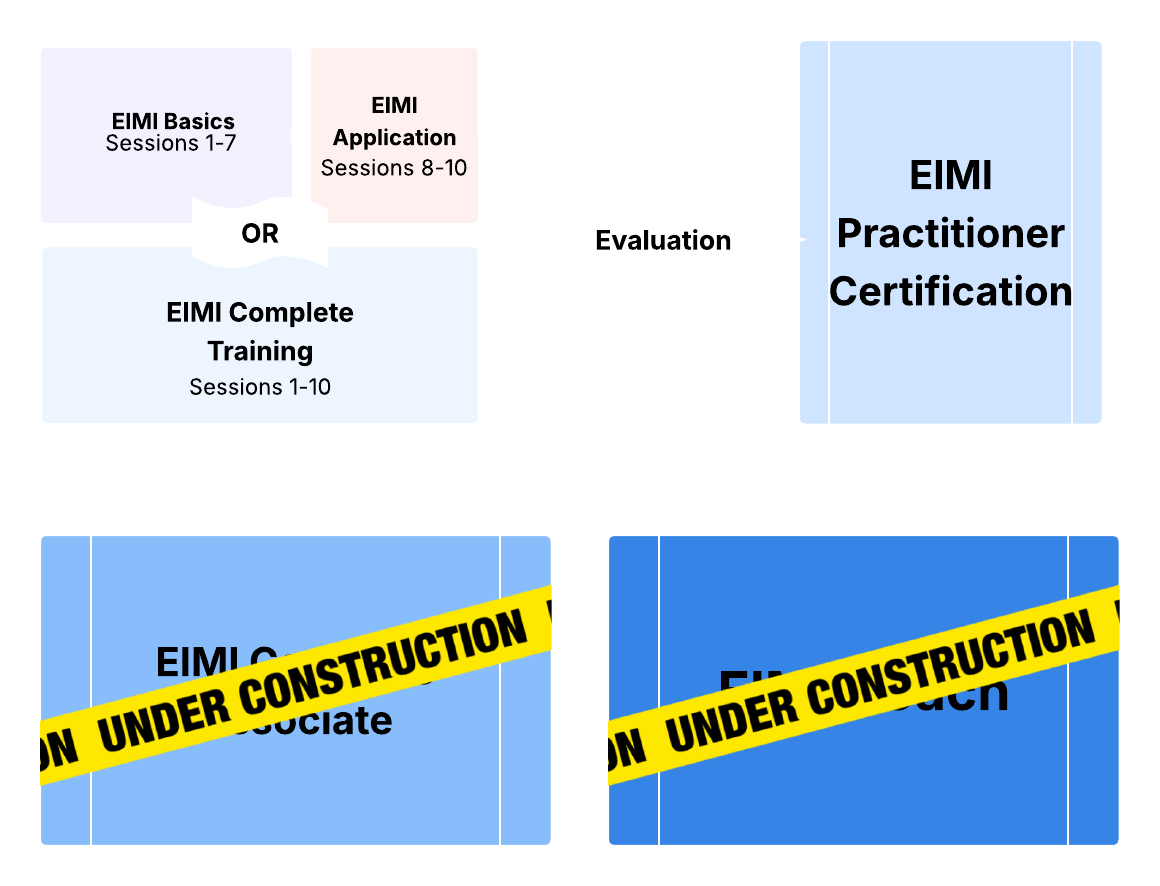
Sessions 1-7
Sessions 1-10
Still want more information?
The EIMI Framework
EIMI isn't a curriculum replacement.
It’s how to teach your curriculum in a way that really hits.
-
Starting with anthropology and psychology, we make the argument that to be human is to be a musician. From that premise, we walk through the traits of trained musicians.
-
You are an educator - a busy educator with a lot on their plate. So we will go over the keys to music psychology in a way that won’t require a new masters to understand, something you can understand and use quickly.
-
You can help your students be ready to learn - no matter what their emotional state is. You just have to TAP (assess your students Tone, Attitude, and Posture) and, if you notice A Distressed Attitude, Posture, or Tone, you ADAPT.
-
Oblivion/Unconscious Incompetence → Awareness/Conscious Incompetence → Effort/Conscious Competence → Ease/Unconscious Competence → Sublimity.
Every skill a student builds moves through these five stages — and most frustration in lessons comes from expecting Ease before a student has finished Effort.
-
There are three main stakeholders for every music educator: The Student, the Parent/Supporters, and The People Who Pay You (administrators). For EIMI to be most effective, you need the right tools to help everyone buy in.
We've stood in that classroom too, in front of a student we couldn't reach, wondering what we were missing.
6600+ Educators
Research Backed
GIA Published
For Every Educator
6,600+ educators trained · Published with GIA Publications · Trainings in 20+ states · International implementation ·
Based in 20+ years teaching · MA in Psychology of the Arts
Paying with a PO?
If your school or institution will be paying for your training and you need us to send them an invoice, use the button on the right to contact us.